Nationwide Survey Underscores Concerns with Use of Topical Steroids and Need for Long-Term Treatment Strategies Facing the 46 Million Americans with Chronic Inflammatory Skin Conditions
- Nearly 9 in 10 adults and parents of children with plaque psoriasis, atopic dermatitis, and seborrheic dermatitis being treated with topical steroids are concerned about side effects
- Nearly 8 in 10 adults and parents agreed that their or their child's treatment plan focuses on reactively “taming a flare” rather than proactive long-term solutions
- When their skin condition is uncontrolled, nearly all adults and children experience emotional, mental, and daily life challenges
WESTLAKE VILLAGE, Calif., Jan. 21, 2026 (GLOBE NEWSWIRE) -- Arcutis Biotherapeutics, Inc. (Nasdaq: ARQT), a commercial-stage biopharmaceutical company focused on developing meaningful innovations in immuno-dermatology, today announced results of Skin Insights: Steroid Perceptions in Chronic Inflammatory Skin Diseases, a nationwide survey of adults and parents of children with plaque psoriasis, atopic dermatitis (the most common form of eczema), and seborrheic dermatitis. The survey was designed to understand patient and parent perceptions and behaviors around the use of topical steroids, as well as perspectives on short-term, reactive treatments versus long-term, proactive disease management.
“Psoriasis is a chronic disease that requires lifelong management — and much the same could be said of seborrheic dermatitis and eczema. This survey highlights an important trend: most treatment plans still focus on a reactive approach focused on taming flares, instead of a proactive, long-term disease management strategy to prevent flares. What’s more, these results demonstrate that even when symptoms are well controlled, many adults and children live with an undercurrent of worry in anticipation of the inevitable next flare. This persistent emotional strain is part of the hidden burden of chronic skin diseases,” said Leah M. Howard, JD, president and chief executive officer of the National Psoriasis Foundation. “These findings suggest a pivotal opportunity for adults and parents of children with psoriasis and other chronic inflammatory skin diseases to explore safe, effective non-steroidal treatment alternatives with their healthcare provider.”
Key findings of Skin Insights: Steroid Perceptions in Chronic Inflammatory Skin Diseases
Adults and parents of children with plaque psoriasis, eczema, and seborrheic dermatitis suffer from frequent, uncontrolled flare cycles and treatment plans that still focus on treating a flare after it has occurred.
The survey of 1,000 adults and 500 parents demonstrated:
- 72% of adults and 80% of children experienced uncontrolled disease at least once a month, and some as often as daily.
- Nearly 8 in 10 adults (79%) and parents (78%) agreed that their/their child's treatment plan focuses on taming a sudden worsening of symptoms, or flare, rather than on long-term disease management focused on preventing flares.
Concern and uncertainty with steroid use remain
Topical steroids are by far the most commonly prescribed topical prescription for these conditions. All survey respondents had been prescribed at least one topical steroid to treat their or their child’s condition at one point in their lives, and the majority (67% of adults and 57% of parents) were prescribed at least one topical steroid to treat their/their child's condition in the last year. Critically, the survey showed:
- The overwhelming majority of adults (88%) and parents (91%) are concerned about at least one short- or long-term side effect of topical steroids, with the top concerns being skin thinning (59% of adults; 55% of parents), lightening of the skin also known as hypopigmentation (46% of adults; 51% of parents), and acne (36% of adults; 35% of parents).
- Despite these concerns, nearly 1 in 2 (48% of adults; 45% of parents) agree they are hesitant to raise concerns with their/their child’s healthcare provider about the long-term use of the topical steroid medication that they have been prescribed to treat their/their child’s inflammatory skin condition.
The “cycle of flares” goes far beyond the visible impact to the skin, resulting in substantial emotional, mental, and daily life challenges.
According to the survey:
- When their skin disease is uncontrolled, adults and children have experienced discomfort throughout the day (65% of adults and 72% of parents), frustration (56% of both groups), embarrassment or self-consciousness (54% of adults and 58% of parents), or anxiety (52% of adults and 44% of parents), and more than half feel uncomfortable in public or social settings (55% of both groups).
- When their or their child’s inflammatory skin condition is uncontrolled, 2 in 5 (40%) adults and parents alike have sought out different treatment options due to anxiety or depression, and over a third (36% of adults and 39% of parents) have sought other options due to side effects.
- Sadly, because their inflammatory skin condition was uncontrolled, adults and children have avoided certain activities, highlighting the high social impact these conditions have when uncontrolled. Of note, nearly half (47%) of adults have avoided meeting up with a friend, and more than half of children have avoided school (54%) or meeting up with a friend (51%), and nearly half have avoided a sports practice or game (43%).
“For the more than 46 million Americans living with atopic dermatitis, seborrheic dermatitis, and plaque psoriasis, these insights have serious everyday implications. This research confirms and builds on a growing body of data indicating the marked social, mental, and emotional burden experienced by adults and children with skin conditions like eczema and seborrheic dermatitis. The combined effect of missing school, avoiding friends, and missing sports could have long-term social consequences and emphasizes the need for treatment plans that focus on proactive disease management as a long-term solution," said Wendy Smith Begolka, MBS, chief program and mission officer, National Eczema Association.
Despite disease being under control, worry and lack of confidence remain.
- Even when the condition appears under control, a majority of adults and children still experience high mental and emotional burden — notably, almost 2 in 3 (59% of adults and 61% of parents) feel self-conscious about scarring or scratches from the last time their disease was uncontrolled, and experience anxiety about when it will become uncontrolled again (57% of adults and 55% of parents).
- Only 1 in 5 adults (20%) and parents (19%) are completely confident they can keep the symptoms of their/their child's inflammatory skin condition under control by relying on the treatment options that their/their child’s clinician has prescribed.
“There’s a growing consensus across the dermatology community that long-term use of topical steroids can carry serious local as well as systemic risks, and there is a desire to move away from episodic care towards more proactive disease management,” said Patrick Burnett, MD, PhD, FAAD, chief medical officer at Arcutis. “These survey findings highlight the real-world challenges adults and parents of children with these conditions face in managing chronic skin diseases and reinforce the need for treatment options that go beyond cyclical care and deliver effective, sustained relief — underscoring the urgent need to redefine what standard of care should look like.”
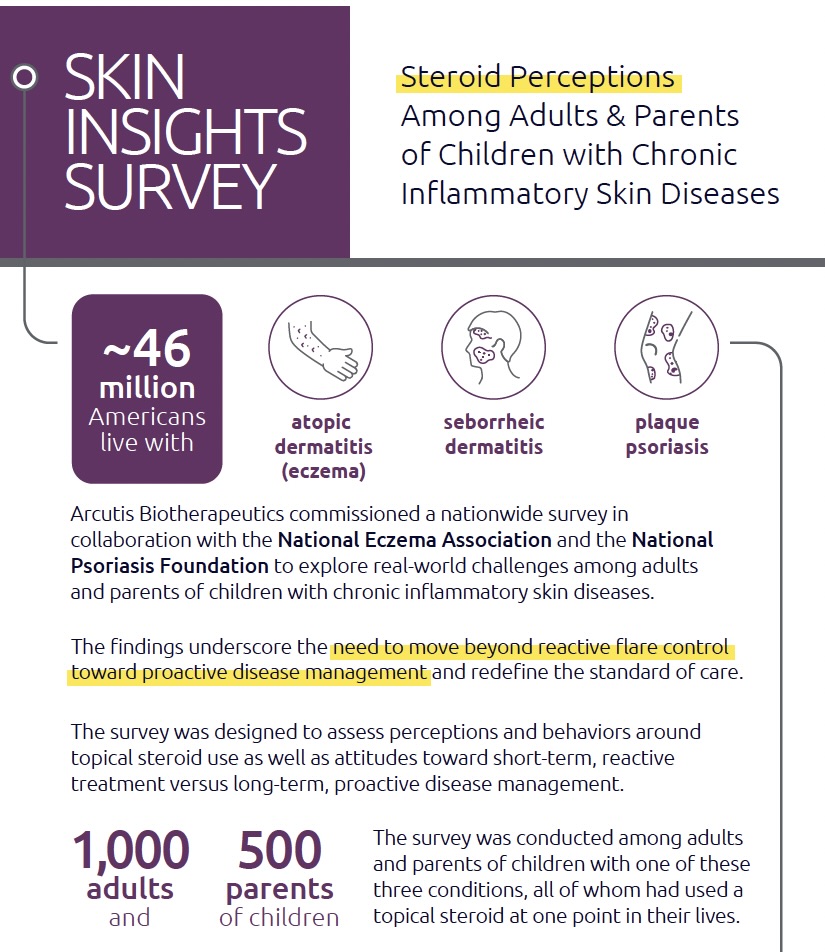
Click to view full survey infographic
About the Survey
The online survey was conducted by Wakefield Research on behalf of Arcutis Biotherapeutics, and in collaboration with the National Eczema Association and the National Psoriasis Foundation, among:
- 1,000 U.S. adults (18+) diagnosed with eczema (atopic dermatitis), seborrheic dermatitis, or plaque psoriasis who have been prescribed a topical steroid at one point in their lives.
- 500 parents of children diagnosed with eczema (atopic dermatitis) ages 6+, seborrheic dermatitis ages 9+, or plaque psoriasis ages 6+, and whose children have been prescribed a topical steroid at one point in their lives. In the survey, parents responded on behalf of their children.
The survey was conducted in August and September 2025.
About Arcutis
Arcutis Biotherapeutics, Inc. (Nasdaq: ARQT) is a commercial-stage medical dermatology company that champions meaningful innovation to address the urgent needs of individuals living with immune-mediated dermatological diseases and conditions. With a commitment to solving the most persistent patient challenges in dermatology, Arcutis has a growing portfolio of advanced targeted topicals approved to treat three major inflammatory skin diseases. Arcutis’ unique dermatology development platform, coupled with our dermatology expertise, allows us to develop differentiated therapies against biologically validated targets, and has produced a robust pipeline for a range of inflammatory dermatological conditions. For more information, visit www.arcutis.com or follow Arcutis on LinkedIn, Facebook, Instagram, and X.
Contacts:
Media
Amanda Sheldon, Head of Corporate Communications
media@arcutis.com
Investors
Brian Schoelkopf, Head of Investor Relations
ir@arcutis.com
A photo accompanying this release will be available at https://www.globenewswire.com/NewsRoom/AttachmentNg/ab84d935-4a78-4034-bcd7-b8e7440fa229


© Copyright Globe Newswire, Inc. All rights reserved. The information contained in this news report may not be published, broadcast or otherwise distributed without the prior written authority of Globe Newswire, Inc.


